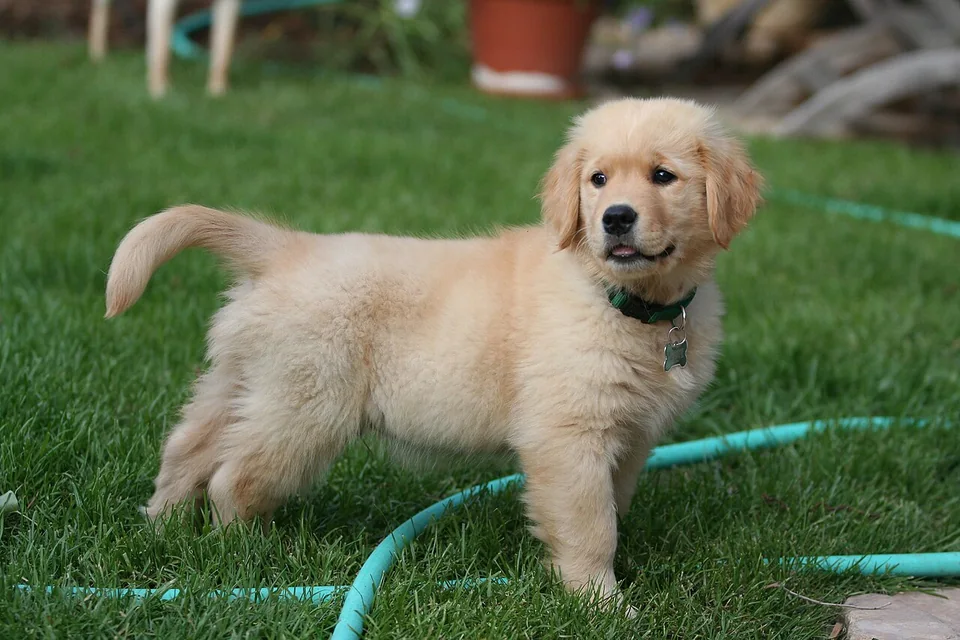
At what age can you tell how big a puppy will be?
You can make a rough guess at 12–16 weeks, and a much better one at 4–6 months. The reason is simple: puppies of different sizes grow on different clocks. A toy puppy may be nearly full-grown at 9 months, while a Great Dane keeps filling out until about 2 years old. The calculator uses a separate growth curve for each size class and shows a range, not a single number, because a young puppy's future still has plenty of wiggle room.
A handy rule of thumb at 16 weeks
| Expected adult size | Share of adult weight at 16 weeks | Multiply by |
|---|---|---|
| Toy (under 12 lb) | about 58% | × 1.7 |
| Small (12–25 lb) | about 48% | × 2.1 |
| Medium (25–50 lb) | about 40% | × 2.5 |
| Large (50–90 lb) | about 33% | × 3.0 |
| Giant (90 lb+) | about 25% | × 4.0 |
Example: a 16-week-old medium-mix puppy weighing 18 lb (8.2 kg) will likely land around 45 lb (20 kg) as an adult — give or take about 10–15%.
Can you tell how big a puppy will be by its paws?
Paws are a fun clue but a poor predictor. Puppy feet grow early, so many pups look like they are "growing into their paws" at 3–5 months. Some breeds, such as Labradors and Saint Bernards, have big feet for their size; others, like Greyhounds, have neat, small feet. The best predictors, in order: the parents' adult weights, the breed or breed mix, and the puppy's weight at 14–16 weeks.
How can you tell if a puppy is going to be a big dog?
- Both parents are large (ask the breeder or shelter for weights).
- The puppy weighs more than about 20 lb (9 kg) at 16 weeks.
- Thick leg bones and a broad head relative to the body.
- Your vet's estimate after a few weigh-ins, plotted over time.
How to weigh your puppy at home and track the growth curve
The answer to "how big will my puppy get?" gets better with every weigh-in. You don't need a vet scale — a bathroom scale works for most puppies:
- Weigh yourself alone and write the number down.
- Pick up your puppy and step back on the same scale.
- Subtract the first number from the second. That's your puppy's weight.
For toy and small dog puppies under about 10 lb, a kitchen scale with a bowl or basket on it is more accurate, because bathroom scales often round to the nearest half pound. Weigh at the same time of day, before a meal, on the same scale.
How often should I weigh my puppy?
Every 1–2 weeks is plenty. Write down the date, your puppy's age in weeks and the weight, then enter your puppy's latest numbers in the calculator. One reading gives a first guess; several readings show whether your puppy is following its growth curve.
Example: two weigh-ins sharpen the puppy size predictor
A medium mixed breed puppy, weighed twice and run through the calculator with no breed selected:
| Weigh-in | Puppy's weight | Share of adult weight reached | Estimated adult weight | Likely range |
|---|---|---|---|---|
| 12 weeks | 13 lb (5.9 kg) | about 28% | ≈ 46 lb (21 kg) | 37–56 lb (19 lb wide) |
| 20 weeks | 23 lb (10.4 kg) | about 51% | ≈ 45 lb (20.5 kg) | 38–52 lb (14 lb wide) |
The estimate barely moved, which tells you the puppy is growing right on its curve. The range shrank by about a quarter because, at 20 weeks, half the growing is already done. If a later weigh-in lands well above or below the expected curve, that's not automatically a problem — but it's a good reason to check body condition and mention it at your next visit.
At what age do puppies gain the most weight?
Puppies double their birth weight in their first week or two, but the biggest gains in pounds come between about 3 and 6 months. A large-breed puppy may gain 1.5–2 lb (0.7–0.9 kg) a week during that stretch; a small breed gains closer to half a pound a week. After 6 months, growth slows and becomes more about height and muscle filling in.
Fast is not always better. Large and giant puppies that grow too quickly have a higher risk of joint and bone problems. Feed a large-breed puppy formula, measure meals and keep your puppy lean — the dog calorie calculator has puppy settings.
Female vs. male puppy weight
Females are usually 10–20% lighter than males of the same breed, and they often finish growing a little earlier. If you choose the sex in the calculator, it narrows the estimate. Typical adult weights from breed standards include:
- Labrador Retriever: males 65–80 lb, females 55–70 lb
- Golden Retriever: males 65–75 lb, females 55–65 lb
- German Shepherd: males 65–90 lb, females 50–70 lb
- French Bulldog: males 20–28 lb, females 16–24 lb
Mixed breed or rescue puppy?
If you don't know the breed, or your puppy is a mix of two very different sizes, use the mixed breed puppy weight calculator. It lets you enter parents' weights or a size guess and shows a wider, more honest range.